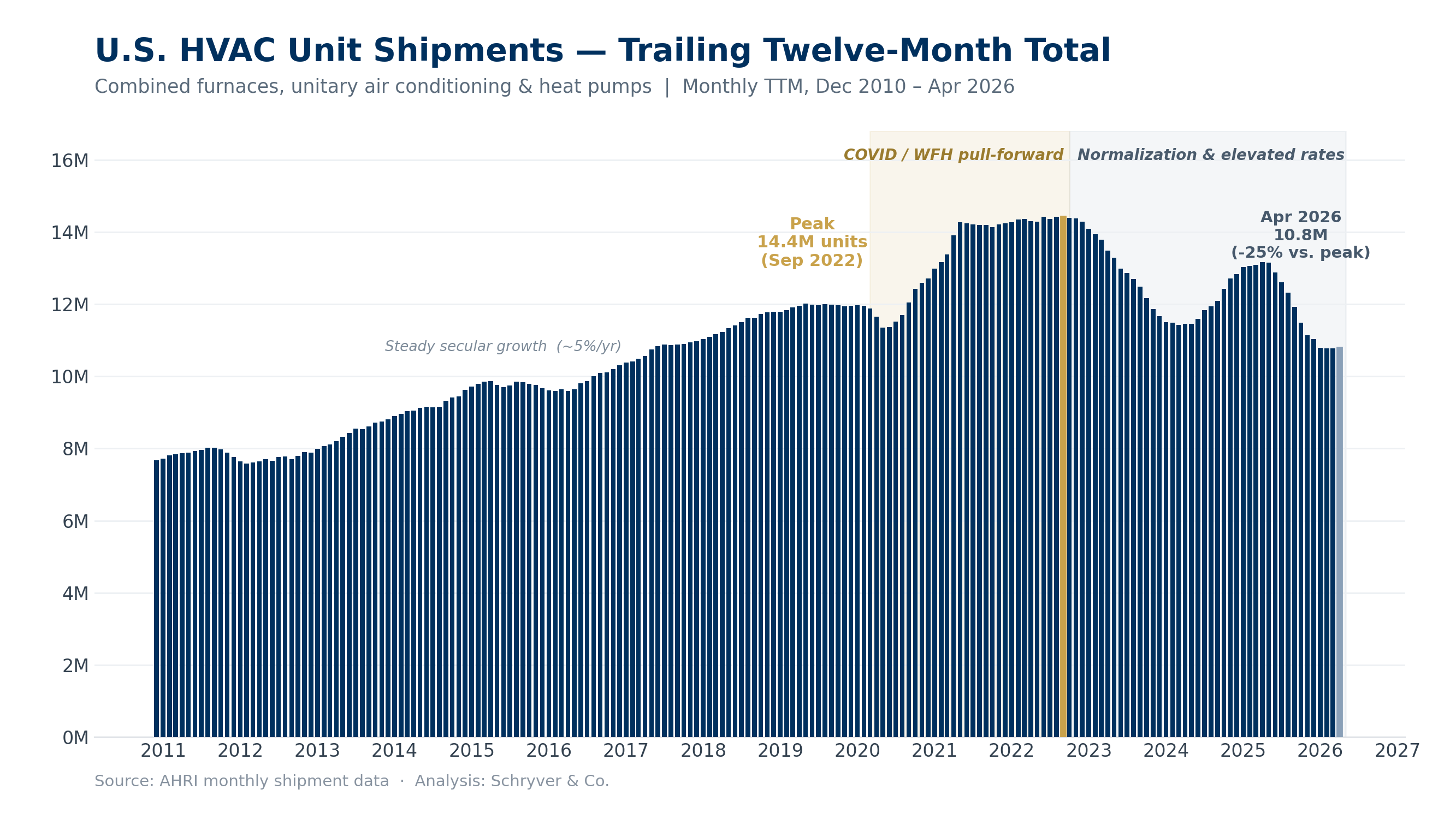
Start with the data, because the data is the puzzle. The chart above is a rolling trailing-twelve-month (TTM) total of U.S. HVAC unit shipments — gas and oil furnaces, unitary air conditioning, and unitary heat pumps combined — built from monthly AHRI shipment figures. Looking at the industry on a TTM basis strips out the heavy seasonality (cooling equipment spikes every summer, heating every fall) and shows the underlying trend: how much equipment the country is actually installing, year in and year out.
For most of the 2010s, that trend was boring in the best way. Total shipments climbed from roughly 7.7 million units in 2010 to about 12.0 million by the end of 2019 — a steady compounding of around 5% per year, tracking housing formation, the aging of the installed base, and replacement demand. No drama. Just a large, essential, slowly growing market.
Then COVID happened, and the line did something it had never done before. The clearest way to see it is to compare the compound annual growth rate (CAGR) of TTM volume across each era:
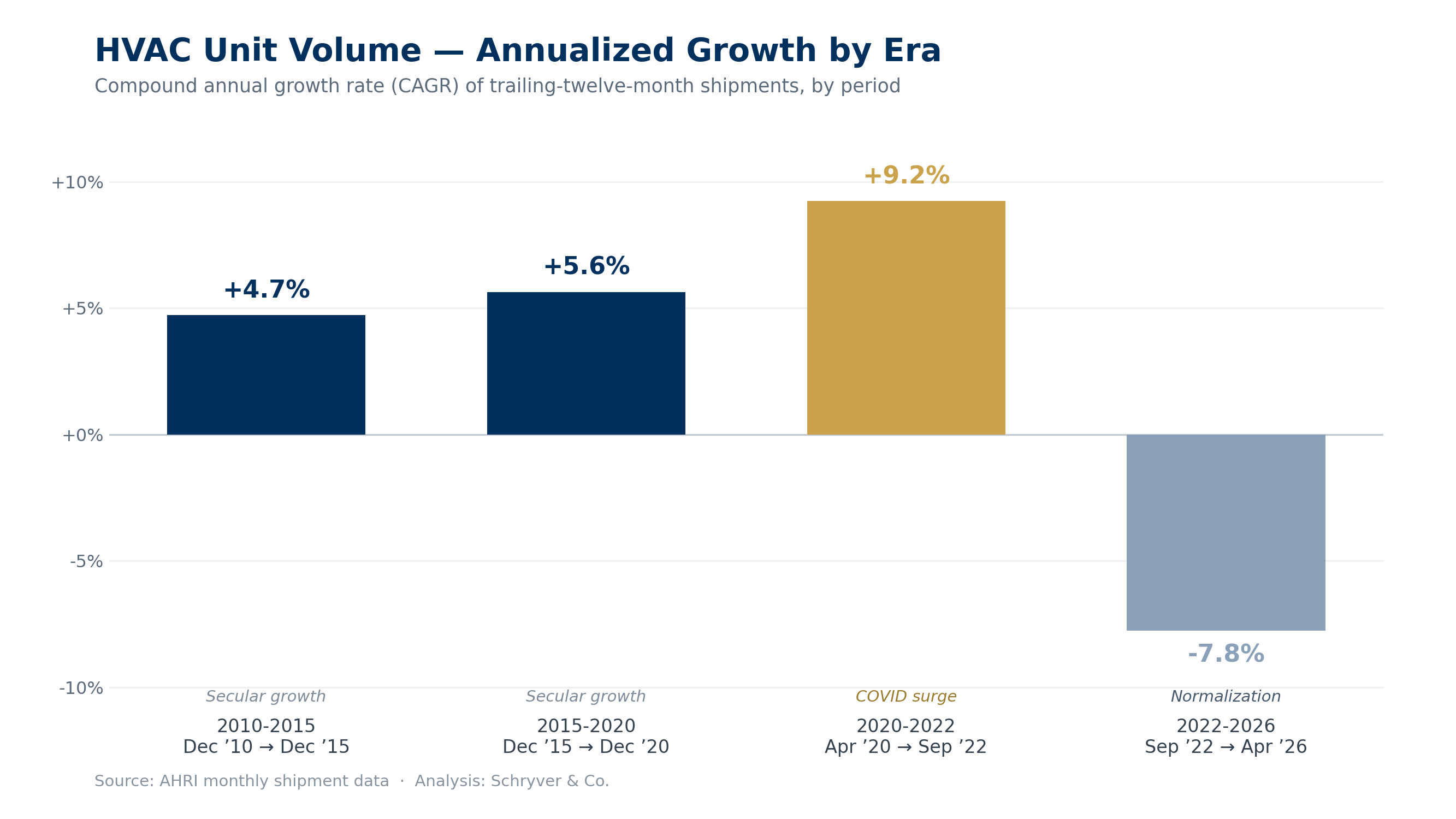
The growth rate roughly doubled, from the ~5% secular trend to about 9% a year through the September 2022 peak. A few forces stacked on top of one another at the same moment. U.S. consumers were suddenly home all day — working and schooling under their own roofs — and they poured money into the houses they were living in around the clock. Stimulus and a frozen services economy redirected discretionary dollars toward home improvement. Mortgage rates near historic lows fueled a housing and refinancing boom that pulled HVAC replacement and new-construction demand forward. And the cost of financing a $12,000 system replacement was about as low as it would ever be.
The key word is pull-forward. A meaningful share of those 2020–2022 installations were not incremental demand; they were future demand brought into the present. A homeowner who replaces a system in 2021 is not in the market again in 2024. That distinction matters enormously for what came next.
The correction.
Beginning in March 2022, the Federal Reserve embarked on the most aggressive tightening cycle in more than four decades, taking the policy rate from near zero to north of 5% in roughly a year and a half and holding it there. It is hard to overstate how abrupt this was — the economy had not seen anything like it since the early 1980s.
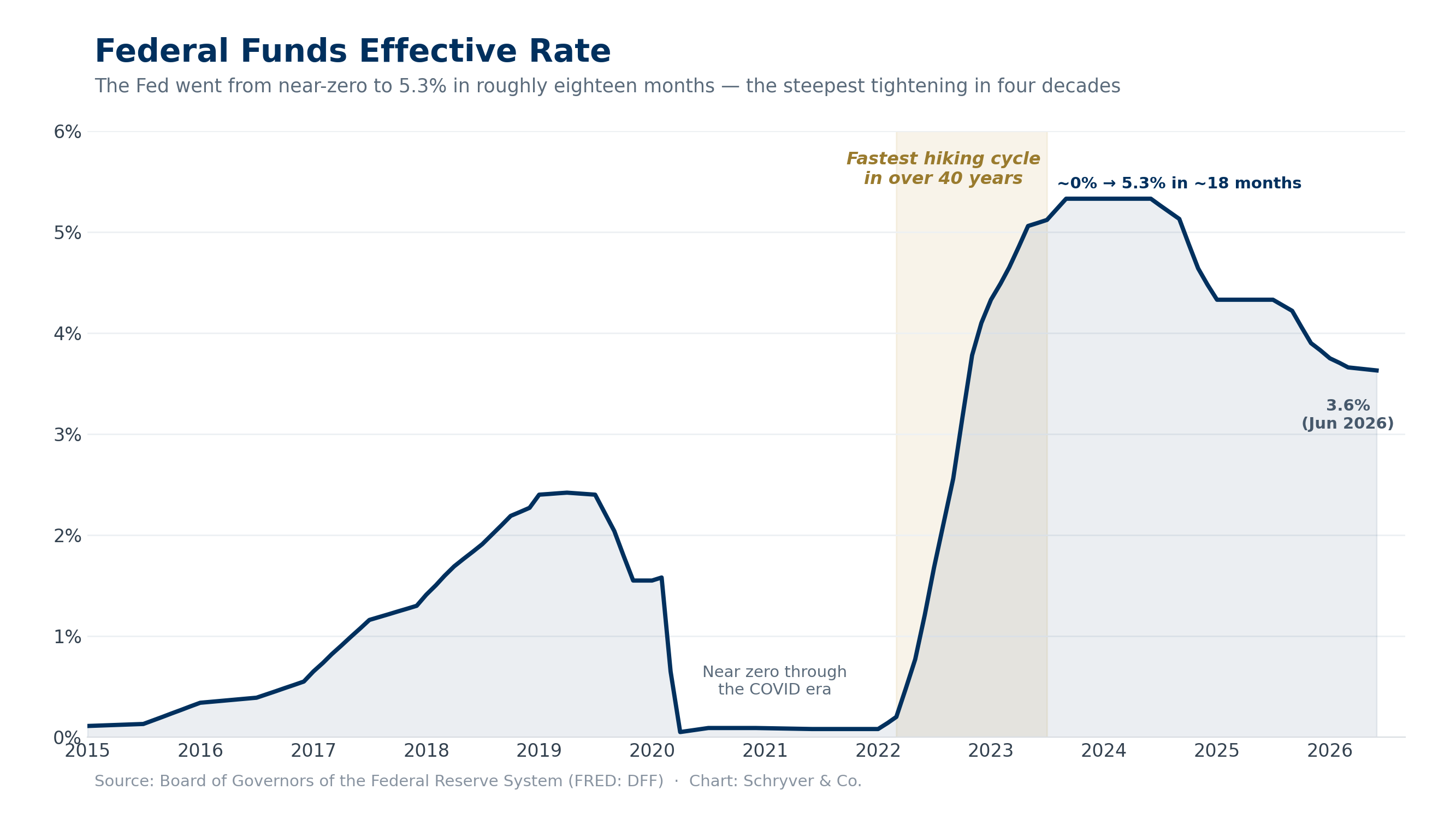
Housing turnover seized up. Financed big-ticket replacements got more expensive at exactly the moment the pull-forward demand was exhausting itself. The result is the right-hand side of the volume chart. TTM shipments rolled over from the 2022 peak and fell hard through 2023, bottoming near 11.7 million units — a level last seen in 2018.
There was a partial rebound through 2024, but it is important to understand what drove it. Much of that bump was itself another pull-forward: a buy-ahead of legacy-refrigerant equipment in front of the 2025 refrigerant transition (the phase-down to A2L systems under the AIM Act). Distributors and contractors stocked up on old-refrigerant units before the changeover, which temporarily lifted the monthly numbers. Once the transition arrived, that channel destocked, and volume softened again through 2025 and into 2026 — sitting at roughly 10.8 million units as of April 2026, about 25% below the peak and back near the industry’s 2017–2018 run-rate. Strip out the refrigerant noise and the underlying signal is unchanged: after years of borrowed demand, the industry has been normalizing, and that normalization is still very much in train.
So the honest read on the industry data is this: we pulled several years of demand forward, and we have been giving it back ever since. The picture is softer, and it has stayed softer longer than many expected.
Now lay the capital cycle on top of it.
Private equity’s interest in residential HVAC predates COVID. The modern roll-up thesis took hold around 2016: a massive, fragmented, recession-resilient market with recurring service revenue, aging owners in need of succession, and obvious professionalization upside. But it was the post-COVID window that turned interest into a stampede.
Annual home-services M&A volume jumped sharply in 2021 over 2020. New platforms were minted across 2020–2022 at a remarkable clip — Apex Service Partners (formed by Alpine Investors in 2019), Redwood Services (2020), Sila, Wrench Group, Turnpoint, and a long list of regional consolidators backed by lower- and middle-market sponsors. Today the number of active, identifiable PE-backed HVAC platforms competing for deals runs into the several dozen — a crowded field of buyers chasing a still-fragmented universe of independents.
Crucially, the capital arrived as the same inflated EBITDA was peaking. Multiples in the 2021–2022 vintage were paid on earnings fattened by the pull-forward. When volume normalized and rates climbed, two things happened at once: the white-hot pace cooled, and the multiples paid for these businesses came down from their peak. M&A activity slowed — but it never stopped.
Air Pros, and the limits of leverage.
The cycle produced its first high-profile casualty. Air Pros, founded in 2017 by Anthony Perera as a two-person Fort Lauderdale shop, grew through aggressive, debt-fueled acquisitions into a roughly 700-employee, eight-state platform — complete with a Miami Dolphins sponsorship. By the time the music slowed, the company was carrying more than $250 million in debt against a normalizing demand environment. In March 2025 it filed for Chapter 11 in the Northern District of Georgia and sold itself off in six separate transactions — the first Chapter 11 of a large-scale, PE-backed home-services platform formed in the recent consolidation wave. Its plan of liquidation was confirmed in September 2025.
Air Pros was not a referendum on the sector. It was a referendum on capital structure and integration discipline: too much leverage, too fast, on EBITDA that proved less durable than the underwriting assumed. But it put a real data point behind a real concern, and it is part of why many sponsors who had penciled in 2023–2025 exits quietly put those realization plans on pause, waiting for a more accommodative backdrop before testing the market.
And then, the reacceleration.
Here is where the story turns. Despite industry data that remains soft, the M&A environment in residential HVAC has picked up considerably from the second half of 2025 into the first half of 2026 — and the character of the buyer has changed. Some of the largest private equity firms in the world, which mostly sat out the frothy 2021–2022 vintage, have decided the sector belongs in their portfolios. A snapshot of the most notable recent platform transactions:
| Date | Investor | Target | EV / EBITDA |
|---|---|---|---|
| Nov 2024 | Goldman Sachs Alternatives | Sila Services | ~17.0x |
| May 2025 | Altas Partners | Redwood Services | ~17.0x |
| Feb 2026 | Blackstone | Champions Group | ~18.5x |
| May 2026 | Redwood Services | Sierra Platform | ~14.5x |
| May 2026 | Apollo (minority) + Alpine | Apex Service Partners | ~18–19x |
| Est. 2026 | TBD — in market | ARS | TBD |
| Est. 2026 | TBD — in market | USA Hometown | TBD |
EV/EBITDA figures reflect reported or widely-cited market estimates and are approximate. ARS and USA Hometown are active processes with buyers and terms not yet determined.
The trajectory is unmistakable. Goldman Sachs Alternatives acquired Sila Services in late 2024. Blackstone’s perpetual-capital vehicle bought Champions Group at a reported ~$2.5 billion and ~18.5x EBITDA in February 2026. In May 2026, Apollo agreed to a roughly $2 billion minority investment in Apex Service Partners at an approximate $10 billion valuation, alongside an additional check from founding sponsor Alpine. Redwood Services — itself majority-recapitalized by Altas Partners at ~$1.1 billion in 2025 — acquired the $100M+ Sierra Platform from SE Capital. And the pipeline is full: GI Partners has ARS in market, and MSouth has taken USA Hometown to market as well.
Step back and the contradiction is stark. Unit volume sits 25% below its peak. Rates are still elevated. Yet the biggest names in private equity are paying high-teens multiples and committing billions of dollars of fresh capital — and family offices, traditionally more patient and more cautious, are pushing directly into the space alongside them. Why now?
The answer is AI.
Not AI inside HVAC — though there is real productivity to be captured in dispatch, scheduling, call centers, and back-office functions. The deeper answer is what AI is doing to everything else.
Artificial intelligence is simultaneously a productivity windfall and a wrecking ball. It is making many businesses dramatically more efficient while rendering others — particularly those built on transactional, repeatable human interactions that a model can now perform — suddenly fragile. And it is happening in days and quarters, not decades. Whole categories are being asked to justify why a human, a call, or a screen is still required when software can do the task instantly and at near-zero marginal cost.
For private equity and family offices, that creates a problem and a tell. The problem: durability has become much harder to underwrite. A business that looks like a compounder today can be structurally impaired by a model release tomorrow. The tell: capital starts hunting for places to hide — cash flows that are insulated from displacement, that benefit from AI on the cost side without being replaced by it on the revenue side.
The skilled trades are close to a perfect fit for that brief. AI can help your HVAC business book the call, route the truck, optimize the schedule, and tighten the back office. It cannot crawl into a 130-degree attic in July to run ductwork, or mount a condenser on the side of a house. It cannot diagnose a failing compressor, pull the permit, or stand behind the warranty. The revenue is physical, local, recurring, and non-discretionary — and it is reinforced by powerful demographics: an aging installed base that needs replacing on its own schedule, and a deep, durable demand for skilled hands that software cannot manufacture. The work simply has to be done by a person, on site, when the system fails — and it always will.
That is the reconciliation. The soft volume data and the elevated-rate backdrop are real, and they are cyclical. The flood of capital is a response to something structural: in a world where AI is quietly repricing the durability of every cash flow it touches, the trades read as a rare combination of essential, defensible, and consolidatable — a place for patient capital to compound safely while so much else is being disrupted.
What it means for independents.
The softness in the unit data is not the signal that matters most for your enterprise value — the capital cycle is. The buyer universe has gotten larger, better-capitalized, and more sophisticated, and the strategic logic pulling it toward the trades is structural rather than a passing fad. Multiples came off their 2021–2022 peak, but they have firmed on a cleaner, more underwritable earnings baseline, and the bid is broadening — from regional sponsors, up to the largest names in private equity, and now to family offices making a deliberate and growing push into the space.
If you have been in the trades long enough, this moment should feel familiar. The energy in the market right now — the pace, the size of the checks, the caliber of the names showing up — rhymes with the intensity coming out of COVID in 2020 and 2021. The difference is that this wave is being driven by structural conviction rather than a temporary demand spike, which is exactly why it has the makings of something more durable. Rates will ease. The pull-forward will fully clear. Volume will resume its long secular climb. And when it does, it will meet a sector that the smartest capital in the world has already decided is one of the best places to be. The interest is accelerating, not fading — and for owners weighing whether and when to transact, there may not be a more compelling backdrop than the one taking shape right now.
Thinking through what this environment means for your business?
We work with operators across residential and commercial HVAC, plumbing, electrical, and adjacent service categories — with an operator’s perspective, not just a banker’s. No pitch, just an honest conversation about where you are and what the market is telling you.
Get in Touch →