2026 has been another active year for pest control M&A. Private equity sponsors have continued to build and add to platforms, national and global strategics have kept filling in geography, and the industry's recurring, route-based economics remain the foundation for the premium valuations this trade has long commanded. Here is how the year's publicly announced U.S. transactions came together, and what we think it means for owners heading into 2027.
The year in M&A
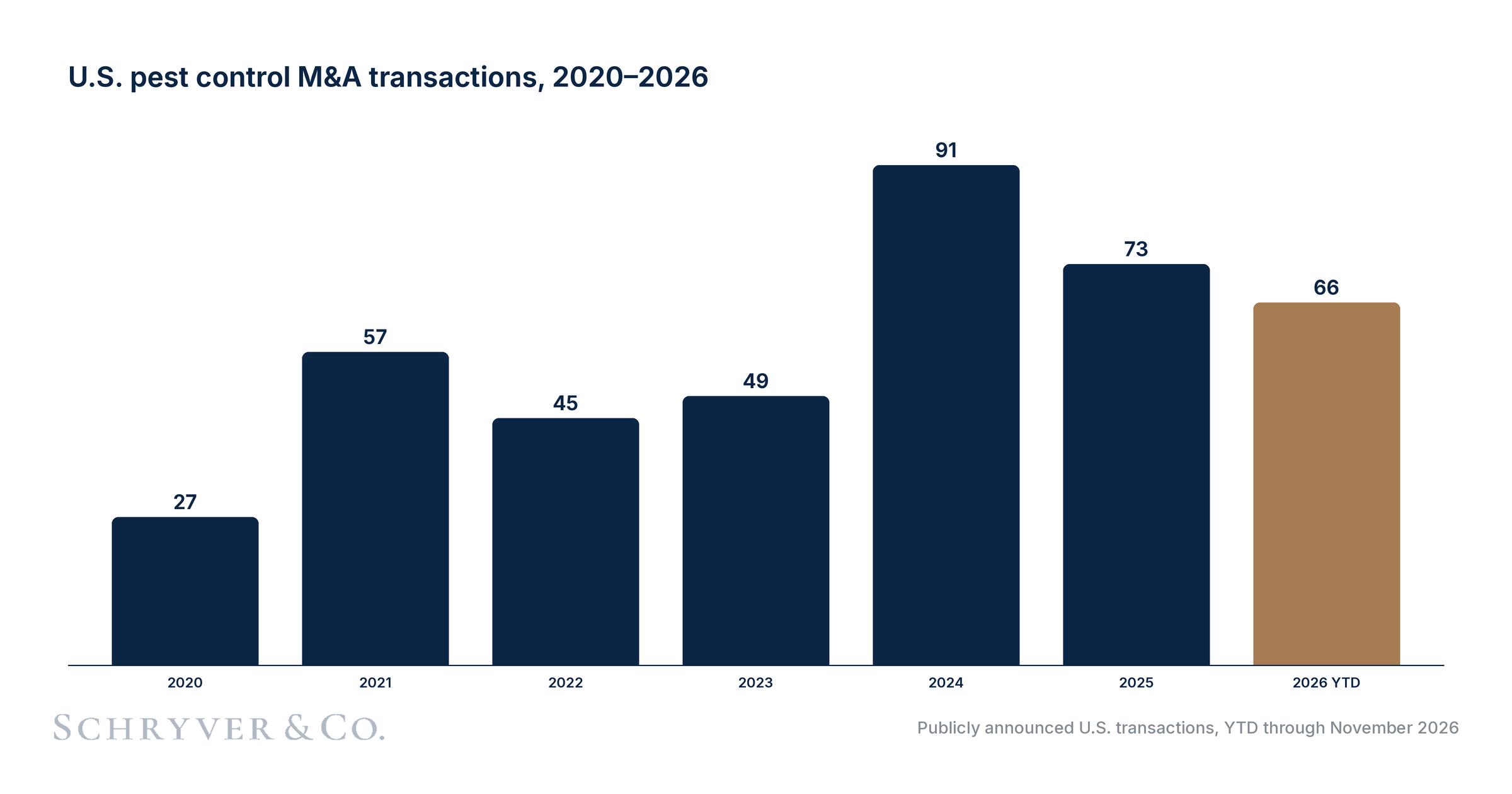
There have been 66 publicly announced U.S. pest control transactions so far in 2026, with a month still left in the year. That follows 73 announced deals in 2025 and 91 in 2024, which was the busiest year in the period we reviewed. Announced volume in the earlier years was 27 in 2020, 57 in 2021, 45 in 2022, and 49 in 2023, so 2026 is tracking as another busy year.
Private equity-backed platforms and sponsors accounted for 46 of the 66 announced transactions this year. There are roughly 38 private equity firms and capital providers active in the space today — core pest platforms, franchise parents, and adjacent lawn and home-services sponsors — a much deeper field of capital than a decade ago. Several of those sponsors only arrived in 2026, including Golden Gate Capital at All U Need Pest Control, Coalesce Capital at ClearDefense Pest Control, Vantage Equity Partners at Catseye Pest Control, and GAF Partners at Hydrex Pest Control. They are just starting to put capital to work.
Strategic buyers have stayed active as well. Rollins announced four U.S. deals this year, and EQT-owned Anticimex was among the most active acquirers, often entering new states under regional brands rather than putting a single national name on every truck.
Valuation multiples
Pest control continues to trade at a premium to the other trades we cover, largely because recurring service plans renew on their own and routes get denser as a company grows. Those same economics, together with a fragmented owner base and a deep bench of private equity and strategic buyers putting capital to work, are what have kept M&A activity elevated. Our published EV/EBITDA ranges for pest, termite, and mosquito service are 7x–11x at $750K–$1.5M of EBITDA, 10x–15x at $1.5M–$5M, and 15x–20x+ at $5M–$10M+. Where a company lands inside the band depends on earnings quality, retention, density, and who is in the process. The ranges and the value drivers behind them are on our pest control valuation multiples page.
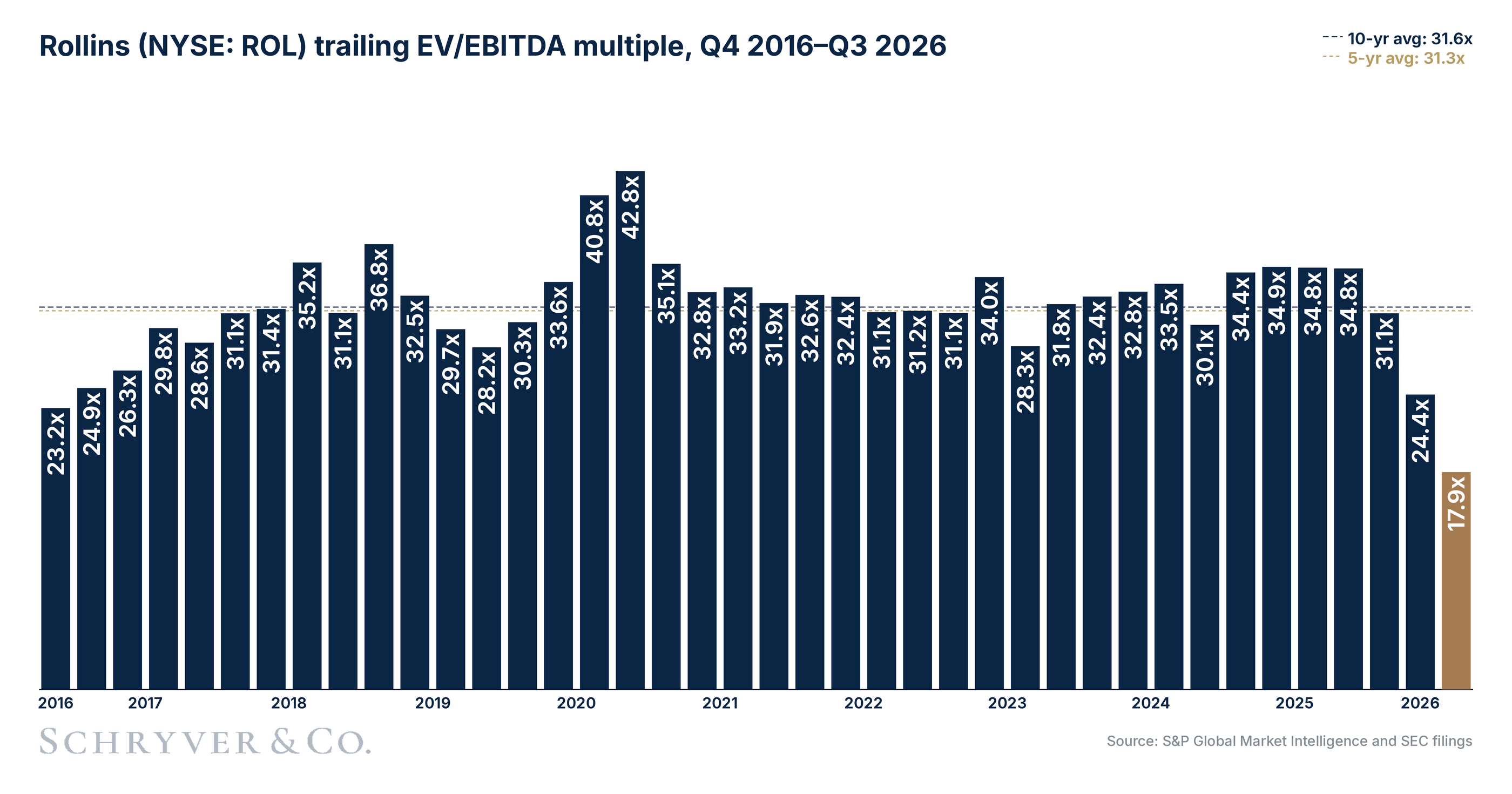
Unlike most other trades we cover, including residential HVAC, pest control also has a true, pure-play public market benchmark in Rollins, Inc. (NYSE: ROL), the parent of Orkin. For five consecutive year-ends from 2021 through 2025, Rollins' trailing EV/EBITDA held at or above 30x, and it finished 2025 at 34.8x. Across the 40 quarters ended Q3 2026, the trailing multiple averaged 31.6x, and 31.3x over the last 20 quarters, with a spike to 42.8x at year-end 2020. In 2026 the share price declined and the quarter-end trailing multiple moved from 34.8x at the end of 2025 to 31.1x in Q1, 24.4x in Q2, and 17.9x in Q3, well below both of those averages. By late November it had recovered to about 22x, still a premium to most public service companies. Rentokil Initial is also public, but it is a broader hygiene and pest platform still digesting Terminix and has typically traded at a lower trailing EV/EBITDA than Rollins, which is the cleaner pure-play benchmark.
Rollins' management has been direct about what they are seeing in their own business this year. On the third-quarter earnings call, CEO Jerry Gahlhoff said the main pressure has been in residential customer acquisition, as AI-driven search changed how homeowners find a pest control provider, and that this is a discovery issue rather than a decline in underlying demand for the service. Retention remained strong, the recurring customer base continued to grow, and the company kept its outlook for 2% to 3% revenue growth from acquisitions in 2026, with what Gahlhoff called a great pipeline of M&A opportunities. CFO Will Harkins described the stock move as a short-term dislocation and said capital allocation priorities are unchanged, with accretive M&A still at the top of the list.
| Platform | Private equity sponsor | Activity |
|---|---|---|
 |  | 57 deals since 2020 4 in 2026, including Choice Pest Management |
 |  | 40 deals since 2020 5 in 2026, including Environmental Pest Management and The Killers Pest Control |
 |  | 39 deals since 2020 4 in 2026 |
 |  | 27 deals since 2020 1 deal in 2026 |
 |  | 14 deals since 2020 5 in 2026, including Patriot Environmental and Pesty Pest Control |
 |  | 14 deals since 2020 2 in 2026 Gridiron acquired the platform from Riata in July 2025 |
 |  | 10 deals since 2020 2 in 2026 |
 |  | New 2026 platform Recapitalized November 2, 2026 |
 |  | New 2026 platform Growth investment, September 2026 |
Notable 2026 deals
The wave of large private equity platform investments did not start this year. In July 2025, Gridiron Capital invested in Greenix Pest Control, one of the largest independent pest control companies in the United States, in a transaction that was also Riata Capital Group's exit from the business. Headquartered in Orem, Utah and founded in 2011, Greenix at the time served more than 250,000 households from 37 branches across 19 markets in 16 states, with a strong presence in the Midwest and the Northeast. That same pattern of large platform recapitalizations carried straight into 2026, as new sponsors arrived and established buyers kept adding scale. Several of this year's transactions are worth a closer look for owners, because they show how capital is coming into the industry and what a well-run operator can still command.
Golden Gate Capital recapitalized All U Need Pest Control. The November 2 recap of the Fort Myers, Florida company was one of the year's clearest new-platform investments. All U Need serves more than 50,000 customers from 12 locations in Florida, Texas, and South Carolina. Founder Steve Groeper and CEO Kyle Selbach stayed on as leaders and shareholders. The growth path matters here. Over the past eight years the company has grown largely organically, including through greenfield branches, rather than by stacking acquisitions, and that kind of repeatable local execution is something sponsors will pay for. We covered the deal here.
Coalesce Capital made a growth investment in ClearDefense Pest Control. In late September, the New York firm backed a 27-location platform operating across 16 states. Founders and management kept a meaningful equity stake and continue to lead the business, which is often a better fit for owners who want to take chips off the table, bring in a partner, and keep building. 2026 showed there is capital for that structure. We covered the deal here.
Vantage Equity Partners invested in Catseye Pest Control. In January, the firm backed the Latham, New York company as a new platform. Catseye is a general pest control and exclusion operator serving customers throughout greater New England. It has already begun putting that capital to work, acquiring Biologic Pest Control in Walpole, Massachusetts and Security Pest Elimination in Lowell, Massachusetts in August. Like the other new 2026 platforms, this one is still early in its add-on program.
Rollins acquired Romex Pest Control. In April, Rollins bought the Pleasant Grove, Utah company for $95.7 million, one of the larger disclosed strategic acquisitions of the year. Romex, founded in 2016, employs more than 200 people, serves customers across four states, and is ranked as a top 40 pest management company in the PCT 100. The brand and local leadership stayed in place, consistent with how Rollins has added companies to its portfolio of brands.
Anticimex entered the Midwest with Environmental Pest Management. EQT-owned Anticimex, already one of the most active acquirers in U.S. pest control, bought the family-owned Columbus, Ohio operator in September and kept the EPM brand. Anticimex has completed 40 publicly announced U.S. deals since 2020, and this one was a geographic entry into the Midwest. The company has often added states this way: buying a well-run local operator and leaving the name on the truck. We covered the deal here.
What operators are seeing in the market
Recurring service is still what the market pays for. General pest plans, termite renewals, and seasonal mosquito programs that come back on the same routes are the reason pest control sits at the top of our valuation ranges. That has not changed. Companies that can show retention, route density, and a clean recurring base remain scarce relative to the capital that wants them.
There is more capital in this industry than there was a decade ago, and more of it arrived this year. Roughly 38 private equity firms and capital providers are active in the space today. New 2026 platforms are just beginning to announce add-ons, and existing platforms — Certus, Anticimex, PestCo, AXN, Greenix, Lookout, Fortress, and others — still have mandates to buy. For a well-run owner, that is a constructive backdrop heading into 2027.
Labor remains a real constraint. Technician hiring, training, and wage inflation still come up in every quality conversation. Routing software and better scheduling help, but they do not replace a stable bench.
Marketing spend and customer acquisition costs have gotten more expensive, and less predictable. On Rollins' third-quarter call, CEO Jerry Gahlhoff said AI-driven search, including large language models, is changing how homeowners find a pest control provider, fragmenting digital lead flow rather than reducing underlying demand for the service. That same shift is showing up across the industry. Paid leads cost more than they did a few years ago, conversion is less consistent, and the return on traditional digital advertising is harder to underwrite. That is why organic referrals, retention, and repeatable local channels matter even more than they used to. Growth that depends on paid demand can fade when the spend stops, or when the next change in how people search reroutes how customers find the company.
What Private Equity Investors and strategics are paying for
Private Equity Investors and strategics are underwriting a handful of things that separate a premium outcome from an average one, and they apply their multiple to the earnings they are willing to believe.
Recurring mix and retention. Buyers look closely at how much of the revenue sits on recurring service plans, how long those customers stay, and whether cancellations are stable or rising. A company with dense, long-duration routes is going to be valued differently from one that is constantly replacing the customers it just lost.
Route density and a technician bench that can run the work. Buyers also look at whether the hours on the route can be scheduled efficiently, and whether the company can operate without the owner still being the best technician in the truck. If the business only works because the founder is still doing the work, that will come up in diligence and it will affect price.
A defensible adjusted EBITDA. Every range we publish is a multiple of adjusted EBITDA, so the more important question is a multiple of what. Buyers apply their multiple to the earnings they will underwrite, not to the number on a tax return or a first-pass add-back schedule. Owner compensation needs to be brought to a market-rate salary, and one-time costs, personal expenses, and related-party arrangements have to be documented or they come out of earnings — and every dollar that comes out comes off the price at the full multiple. Getting that adjusted EBITDA right, and documenting it before a company goes to market, is more important than trying to pin down the precise multiple in isolation. A large part of our work with owners happens at this stage, before we speak with a prospective buyer, so that when a multiple is applied, it is applied to the right number.
Management depth and a credible transition. The best 2026 recaps and growth investments — All U Need, ClearDefense — left founders and senior leaders in place, with equity still on the table. Buyers will pay for a company that can run after the deal, and they will pay less for a company that cannot.
Evidence of organic growth, not only acquired growth. A roll-up's value depends on buying the next company at the right price. A company that can also open a branch, win customers on the route, and keep them is telling a different, and usually stronger, story. That is a large part of why a recap like All U Need stood out this year.
A crowded field of platforms does not make for an easier process. More capital means more potential counterparties, and it also means more diligence. Add-backs get tested, customer lists get tested, and owner dependency gets tested. Platforms that have already done a dozen integrations are faster and more exacting than a first-time buyer. The owners who get the best outcomes in this market are the ones who get their earnings and reporting ready before the first call, not during it.
Publicly announced transactions only tell part of the story. Rollins, Rentokil, and the more active platforms regularly close smaller tuck-in acquisitions without issuing a press release, so actual deal volume is meaningfully higher than what shows up in announcements. A quieter week of press releases is not, by itself, a sign that buyers have stepped away.
Looking ahead to 2027
Heading into 2027, there is still a lot of capital pointed at this industry. New platforms that were capitalized in 2026 have unused add-on capacity, established private equity-backed platforms are still building density, and strategics are still filling white space, as Anticimex did in Ohio and Oregon this year. The underlying economics — recurring plans, route density, and an essential service — have not changed, and pest control still sits at the top of the valuation ranges we publish.
Not every company will transact at the top of the range, and 2027 is unlikely to be a straight line from 2024's M&A activity. Buyers will stay disciplined on quality of earnings, labor will still be tight, and public multiples will move with the market. For an owner thinking about a sale or a recapitalization in the next 12 to 18 months, the work that moves price is getting the earnings, the retention, the routing, and the management story into a form a buyer can underwrite.