Eastside Exterminators, the Woodinville, Washington pest control company owned by Swedish pest control group Anticimex, has acquired The Killers Pest Control, a family-owned Portland, Oregon company that has served the area since 1982. Pest Management Professional reported the finalized acquisition in September, and on November 12 The Killers announced the deal publicly, framing it in a letter to customers as a “partnership.” Financial terms were not disclosed.
The asset.
The Killers treats ants, bed bugs, termites, cockroaches, rodents, bees, wasps, spiders, and fleas for homes and businesses across Portland, from downtown and the Pearl District to St. Johns, Sellwood, and Multnomah Village, with its office on SW Barbur Boulevard. Every job starts with a free inspection, treatment plans are built around what the technician finds, and covered work carries a year-long guarantee. Pest Management Professional puts the business at more than 8,500 residential and commercial customers across three branches, led by owners Matthew White and Felicia Hirata. White is a past president of the Oregon Pest Control Association.
The customer letter says the same technicians will keep servicing the same properties. “Eastside Exterminators will uphold the same high standards The Killers has built its reputation on,” White wrote. “You’ll continue working with the team you already know and trust.”
The buyer.
Eastside was founded in 1969 by Ralph James Townsend Jr. and run for two decades by his daughter, Deanna Townsend, and her business partner, Alex Altizer, before Anticimex bought it in October 2022 as its entry into Washington State. At the time, Bill Talon, president of Anticimex South & West North America, called it a chance to pair Eastside’s staff with Anticimex’s “cutting-edge Smart technologies” and to become “a leading provider of pest management services in the Pacific Northwest.” Alongside pest and rodent control, Eastside runs insulation, exclusion, and crawlspace work. Jason Kosenski has been president since October 2025. “We are thrilled to welcome The Killers Pest Control team into the Eastside family,” he said in the customer letter.
Anticimex was founded in Sweden in 1934 and says it now operates in 21 countries with 12,000 employees, about 260 branches, and total revenues of SEK 17.1 billion in 2025, with more than 440 acquisitions behind it. EQT has owned the company since 2012. In November 2021, EQT’s longer-hold fund, EQT Future, took a controlling stake at an enterprise value of SEK 60 billion, alongside long-term investors including Melker Schörling AB and GIC.
Building the Pacific Northwest one family business at a time.
Anticimex entered the U.S. in 2016 by acquiring regional companies, including American Pest in Maryland, and has kept doing so, keeping local brands as regional platforms that then add smaller companies of their own. Its U.S. service-area map now shows 18 brands, from Eastside in Washington to Turner Pest Control in Florida. In the Pacific Northwest it has followed the same playbook: Eastside in 2022, then Eastside’s purchase of Parker Eco Pest Control, a 2016 family company serving the Seattle metro, Everett, and Bellingham, in March 2026, and now The Killers.
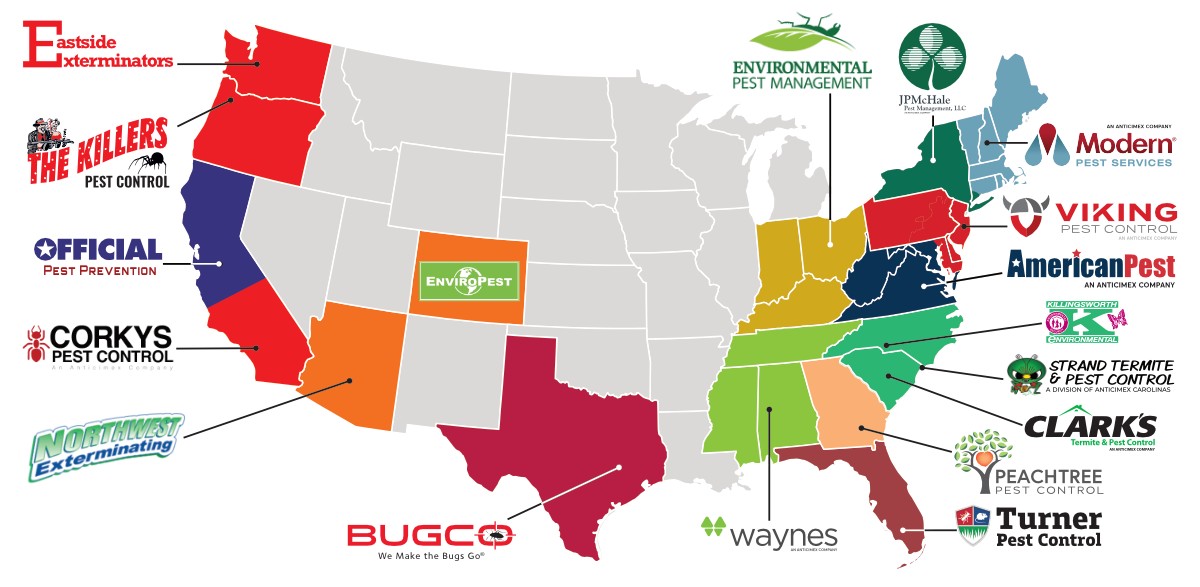
Parker Eco added density inside Western Washington. The Killers is different: it is the only Oregon brand on Anticimex’s map, and it sits between Eastside in Washington and Official Pest Prevention and Corkys in California. Portland gives Anticimex a continuous run down the West Coast, and it does so through a 44-year-old local name with an established customer base, rather than a greenfield branch competing for referrals in a new market. Running it through Eastside rather than as a standalone platform keeps the deal regional: Portland is about three hours down I-5 from Eastside’s base, close enough to run as one Pacific Northwest operation.
Insulation and SMART: more to sell to the same customers.
The customer letter names two services The Killers did not previously offer: insulation installation and repair, and digital pest control such as Anticimex’s SMART system. Both repeat what Eastside did with Parker Eco, whose customers gained insulation through Eastside Insulation, Puget Sound Energy weatherization rebates, and SMART rodent detection. The logic is cross-selling. Rodent work often leads straight into exclusion, crawlspace cleanup, and insulation replacement, which are bigger jobs than a quarterly service visit. SMART turns rodent monitoring into a connected, around-the-clock subscription. Anticimex reports more than 601,000 SMART devices installed and 91% customer retention, and its owner has made SMART adoption central to the investment case. For a buyer like that, a residential and commercial book of 8,500-plus customers in a new metro is a base for both.
A consolidating industry, and a buyer that keeps local names.
Pest control remains one of the most active corners of home and commercial services M&A. Anticimex itself describes the market as “highly fragmented with significant potential for consolidation.” At the top, Rentokil Initial closed its $6.7 billion acquisition of Terminix in October 2022 and set out a plan to consolidate more than 600 combined branches into about 400. Rollins paid $350 million for Fox Pest Control in 2023 and folded it into HomeTeam Pest Defense. Below them, private equity–backed platforms are buying in the same markets: Certus folded Puyallup’s Standard Pest Control into its Seattle-area Purcor operations in September, and this fall alone brought Certus’s Treasure Coast tuck-in, AXN Growth Partners’ two Arizona add-ons, and new sponsor capital behind All U Need and ClearDefense.
Anticimex sits between those two models. It is a global strategic with long-hold private equity ownership, it keeps sellers’ brands and crews in place, and it now enters new states through its regional platforms as well as at the group level. In September it entered the Midwest by acquiring Environmental Pest Management in Columbus, Ohio. Two new-state entries in the same quarter show a buyer filling in its U.S. map steadily, often from regional companies it already owns rather than new platforms.
What it means.
For pest control owners in Oregon, Washington, and the rest of the West, there are now at least two well-funded buyers in the Pacific Northwest: an Anticimex platform that has completed two add-ons this year, and a Certus-owned Purcor branch network adding in the Seattle area. Eastside’s deals point to the profile it likes: a family-owned business with decades of local reputation, a recurring residential and commercial book, and a customer base where rodent work, exclusion, and insulation can be added on top. Owners with that mix, especially near I-5 between Bellingham and Portland, are the natural next conversations.
Own a pest control business?
Curious how a strategic or a private equity–backed platform would look at your routes? Schryver & Co. advises trades owners with roughly $5 million to $100 million of revenue. Reach Will at will@schryverco.com.
Talk with Will →