On July 14, 2026, Skybound Service Partners announced three new partnerships and four greenfield locations, capping a first year in which a platform that did not exist eighteen months ago has grown into a nine-market commercial roofing business stretching from the Northeast to Texas and from Minnesota to Florida. It is one of the cleaner illustrations yet of the buy-and-build model arriving in commercial roofing — and of how quickly a well-capitalized platform can compound once the machine is running.
Skybound was founded in June 2025 with backing from Garnett Station Partners, a New York-based principal investment firm that manages roughly $4.5 billion of assets. Its model is the now-familiar founder-friendly template: partner with best-in-class, entrepreneur-led commercial roofing operators, keep their brands and local leadership in place, and layer on institutional capital, technology, and growth infrastructure. What sets Skybound’s pitch apart is how heavily it leans on technology — proprietary AI tools, drone-based roof inspection and assessment, construction-management and estimating software, and predictive analytics — which the company credits for 15%+ organic growth across the portfolio while preserving each partner’s culture and identity.
The five partners — and the map they build
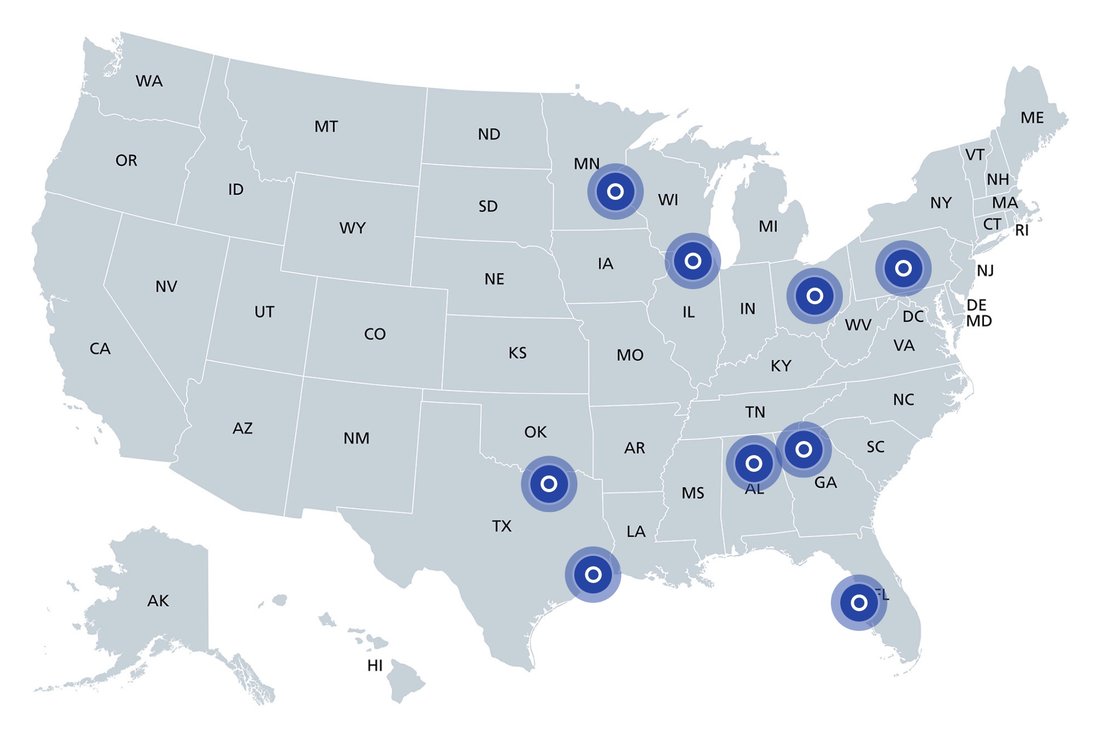
Skybound’s footprint has been assembled through five partnerships in roughly a year, each retaining its own brand and management team. The two founding partners came aboard in the summer of 2025: Roof Technology Partners, founded in 2011 in Woodstock, Georgia, with operations across the Southeast and Texas; and Quality Trusted Commercial Construction & Roofing, founded in 2005 in Minneapolis, serving the Midwest.
The three newest partners, announced in this update, extend the map materially. David M. Maines & Associates, founded in 1989 in Lewistown, Pennsylvania, brings operations across the Mid-Atlantic and Northeast. Unicoat Industrial Roofing, founded in 2000 in Bradenton, Florida, adds a presence across Florida and the Southeast. And Technique Roofing Systems, founded in 1992 in Helena, Ohio, extends the platform across Ohio and the Midwest. Layered on top of the acquisitions are four greenfield branches launched over the past twelve months — in Houston, Dallas, Birmingham, and Chicago — that fill in major metros between the acquired footholds.
Two engines: acquisition and organic growth
What distinguishes Skybound’s first year is that it is running two growth engines at once. The acquisition engine is the familiar one — partner with established regional operators, preserve their brands, and deepen the map deal by deal. The greenfield engine is less common in early-stage roll-ups: rather than waiting to buy into a market like Houston or Chicago, Skybound has stood up its own branches there, using the platform’s shared infrastructure and technology stack to build presence organically. Founder Jack Miner framed the announcement as evidence of exactly that combination — scaling through both organic and acquisition-driven growth — while CEO Joe Dougherty pointed to a $50 billion market with, in his words, significant runway ahead.
The 15%+ organic growth figure is the number worth sitting with. In a fragmented, project-driven business like commercial roofing, organic growth of that magnitude across a multi-brand portfolio is the hardest part of the model to execute — and it is what platform buyers ultimately get rewarded for at exit. Acquisitions build the map; organic growth builds the multiple. Skybound is claiming both early, which is why the first-year cadence reads as momentum rather than simply activity.
Why commercial roofing, and why now
Commercial roofing has the profile that draws buy-and-build capital. It is a large, fragmented market served mostly by independent, founder-owned regional contractors, many reaching a natural transition point. Demand is substantially non-discretionary and recurring in character: roofs fail, leak, and reach end-of-life on their own schedule, and re-roof, recover, repair, and maintenance work renews regardless of the broader construction cycle. National and multi-site customers — retailers, property managers, and industrial owners — increasingly want a single roofing relationship with consistent standards across every location, a demand only a scaled platform can serve.
Skybound is not alone in seeing this. Garnett Station itself is a recurring name across the trades — it backs the FirstRidge residential roofing platform and the Grizzly MEP commercial mechanical platform — and the broader commercial roofing space has drawn AEA Investors into Nations Roof, FirstService into Roofing Corp of America, and a widening field of regional consolidators. The competitive dynamic that has reshaped HVAC over the past several years is now firmly underway in commercial roofing.
What it means for commercial roofing owners
For an owner of a commercial roofing business, Skybound’s first year is a useful and specific data point — not because of any single deal, but because of what the platform is paying up for. Three things stand out. First, the buyers competing for commercial roofing assets are multiplying, and they are well-capitalized: a firm managing $4.5 billion can move decisively and fund both acquisitions and de-novo branch growth. Second, these platforms increasingly compete less on whether they will keep your brand and team — most now promise to — and more on what they actually deliver afterward: technology, capital for growth, national-account access, and shared infrastructure. And third, the attributes that command the strongest interest are identifiable in advance — durable recurring service and maintenance revenue, a clean and diversified customer base, national or multi-site relationships, self-perform crews, and demonstrated organic growth.
Every one of those is something an owner can influence well before taking a call. Skybound’s emphasis on organic growth and technology-enabled efficiency is a signal about what the best platforms now value most: not just a book of work, but a business that can keep growing under new ownership. The practical questions for a seller are the ones worth pressure-testing before a process ever starts — how a given platform’s structure, deal terms, and post-close support actually work, how much local autonomy survives in practice, and, critically for a partnership model built on rolled equity and long-term upside, what the second bite of the apple is really worth when the platform itself is sold. Those answers vary widely from buyer to buyer, and they matter as much as the headline valuation.
Own a commercial roofing business and watching platforms like Skybound?
Well-capitalized platforms are building fast across commercial roofing — competing on technology, growth capital, and national-account reach, not just price. What your business is worth to one, and which model actually fits what you’ve built, is worth understanding before the phone rings. We work with owners and acquirers across the trades — no pitch, just an honest read.
Get in Touch →